On-Grid vs Hybrid Solar Systems in Kerala: Which One Fits Your Home?
Choosing between an on-grid and hybrid solar system in Kerala is not a technical decision, it is a practical one based on how your home consumes electricity, how often you face power cuts, and how much you are willing to invest upfront. Many homeowners assume hybrid is always better because it includes battery backup, but…
Choosing between an on-grid and hybrid solar system in Kerala is not a technical decision, it is a practical one based on how your home consumes electricity, how often you face power cuts, and how much you are willing to invest upfront. Many homeowners assume hybrid is always better because it includes battery backup, but in reality, the right choice depends on usage patterns and local conditions rather than features alone.
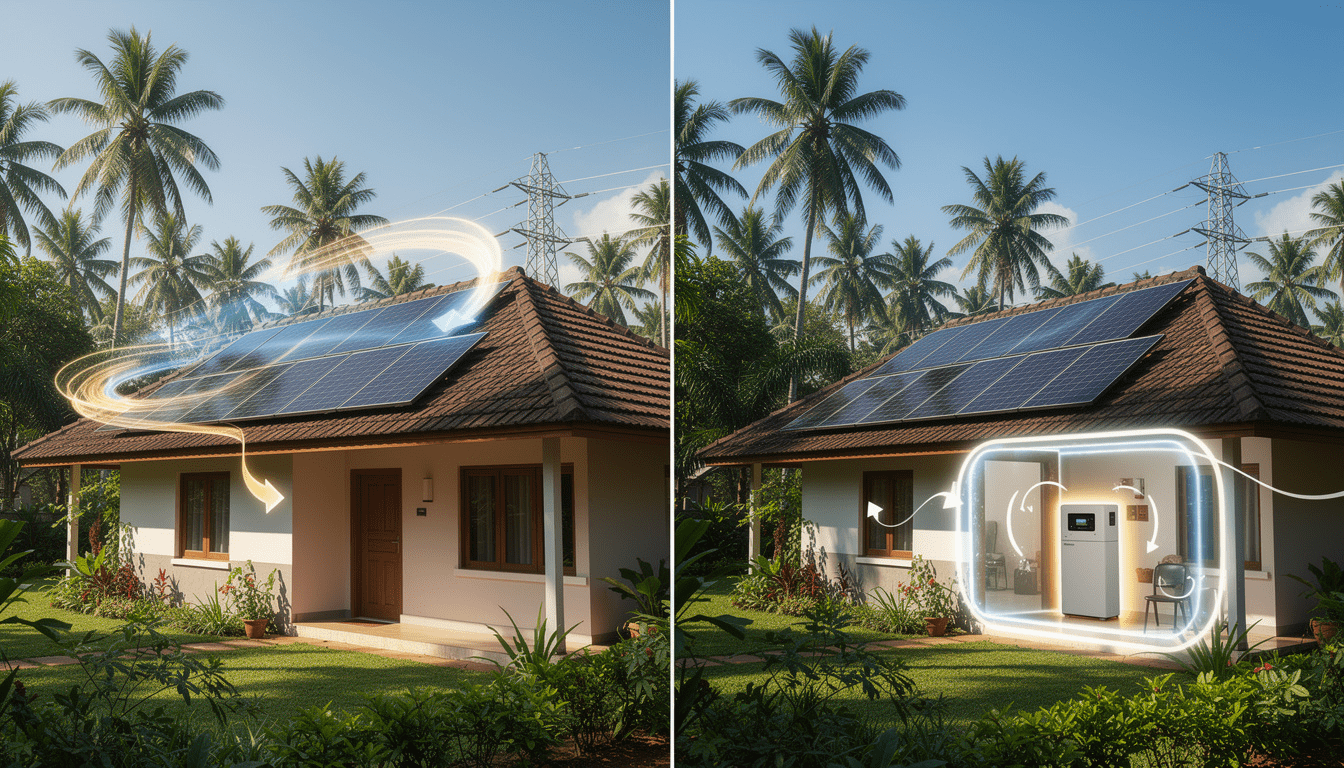
An on-grid solar system is directly connected to the electricity grid and works without batteries. During the day, it generates power from sunlight and supplies it to your home. If your system produces more electricity than you use, the excess is exported to the grid through net metering, and you get credits that offset your nighttime consumption. At night, when the system is not generating power, you simply draw electricity from the grid. This setup is the most common in Kerala because it is cost-effective and aligns well with the state’s relatively stable power supply in most urban and semi-urban areas.
A hybrid solar system, on the other hand, combines solar generation with battery storage. It works similarly during the day, but instead of sending all excess power to the grid, it stores some of it in batteries. This stored energy can then be used during power cuts or at night, reducing dependency on the grid. Hybrid systems are particularly useful in areas where power outages are frequent or where uninterrupted power is critical, such as homes running medical equipment, home offices, or businesses.
The first major difference between the two is cost. An on-grid system in Kerala typically costs around ₹55,000 to ₹70,000 per kW before subsidy. A 3 kW system might cost around ₹1.8 lakh to ₹2.2 lakh, which reduces significantly after subsidy. A hybrid system, however, can cost 40% to 80% more depending on the battery capacity. For the same 3 kW setup with batteries, the cost can easily go beyond ₹3 lakh. This higher initial investment directly affects your return on investment and extends the payback period.
From a savings perspective, on-grid systems usually offer faster returns. Since there are no batteries involved, there are fewer components to maintain or replace. Most of the electricity generated is either consumed or exported efficiently, making the system financially optimized. In Kerala, where net metering policies are well-established, this model works effectively for reducing electricity bills. Many homeowners are able to bring their bills down to minimal fixed charges using on-grid systems alone.
Hybrid systems, while offering energy independence, introduce additional variables. Batteries degrade over time and typically need replacement within 5 to 8 years depending on usage and type. This adds to long-term costs. Also, if your area rarely experiences power cuts, the battery may not be utilized enough to justify its cost. In such cases, the extra investment does not translate into proportional benefits.
Power reliability is where hybrid systems have a clear advantage. During a power cut, an on-grid system shuts down automatically for safety reasons, meaning you will not have electricity even if the sun is shining. A hybrid system continues to power essential loads using stored energy and solar generation. This makes a noticeable difference in areas of Kerala that still experience frequent outages, especially in rural or hilly regions.
Another factor to consider is how you use electricity. If most of your consumption happens during the daytime, such as running appliances, working from home, or operating small businesses, an on-grid system already gives you maximum benefit because you are directly consuming solar power as it is generated. If your usage is heavily skewed toward nighttime, a hybrid system can help reduce grid dependency by using stored power, but again, this comes at a higher cost.
Space and installation complexity also play a role. Hybrid systems require additional space for batteries and involve more complex installation and system management. On-grid systems are simpler, easier to maintain, and generally have fewer points of failure. For most residential rooftops in Kerala, especially in urban areas, simplicity often translates to reliability.
So which one fits your home? If you live in an area with stable electricity supply, have moderate to high daytime usage, and are looking for the best financial return, an on-grid system is usually the right choice. It minimizes your investment while maximizing savings through net metering. If your area faces frequent power cuts, or if uninterrupted power is a necessity for your home or work, a hybrid system becomes more relevant despite its higher cost.
The key is not to choose based on features, but on actual need. Solar is a long-term investment, and the right system is the one that aligns with your consumption pattern, local power conditions, and financial expectations. In Kerala’s context, on-grid systems work for the majority, while hybrid systems serve specific use cases where backup power is not optional but essential.