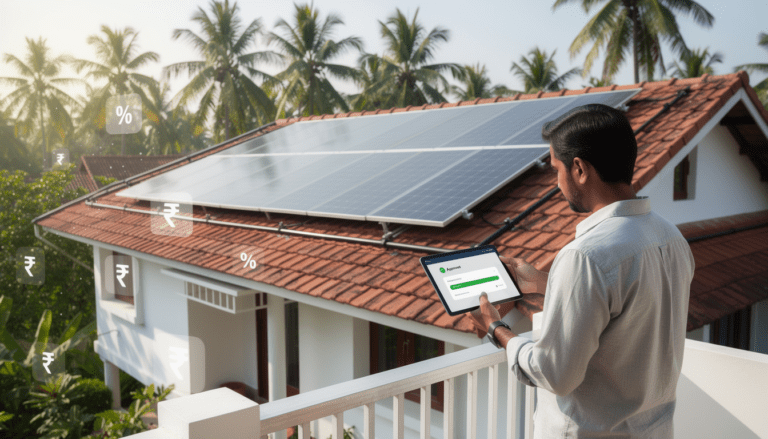

Is Solar Worth It in Kerala? A Practical Cost vs Savings Breakdown for Homes
Electricity cost in Kerala has been steadily increasing, and most households today fall into higher tariff slabs once monthly usage crosses 200–300 units. A typical 2–3 BHK home with fans, lights, refrigerator, washing machine, and occasional AC usage can easily consume 250 to 500 units per month, resulting in bills ranging anywhere between ₹1,500 to…
Electricity cost in Kerala has been steadily increasing, and most households today fall into higher tariff slabs once monthly usage crosses 200–300 units. A typical 2–3 BHK home with fans, lights, refrigerator, washing machine, and occasional AC usage can easily consume 250 to 500 units per month, resulting in bills ranging anywhere between ₹1,500 to ₹5,000 or more depending on usage patterns and slab rates set by KSEB. This is where solar starts becoming less of an “eco-friendly option” and more of a financial decision. The question is not whether solar works in Kerala, but whether the numbers justify the investment for your specific usage.
Kerala actually has strong solar potential despite its monsoon season. On average, the state receives 4 to 5 peak sun hours per day annually, which is sufficient for residential solar systems to generate consistent output. A properly installed 1 kW solar system can generate roughly 4 to 5 units per day, translating to around 120 to 150 units per month. So if your home consumes 300 units monthly, a 2 to 3 kW system can offset a major portion of your electricity bill.
Let’s break this down with a practical example. Consider a household consuming 350 units per month, paying an average of ₹7 per unit when slab rates are considered. That puts the monthly bill around ₹2,450 and yearly electricity expense close to ₹29,000. Installing a 3 kW on-grid solar system in Kerala typically costs between ₹1.8 lakh to ₹2.2 lakh before subsidy. With central government subsidy schemes, this cost can drop by ₹60,000 to ₹80,000 depending on eligibility, bringing the effective investment closer to ₹1.2 lakh to ₹1.5 lakh.
Now look at the savings. A 3 kW system can generate approximately 360 to 450 units per month, which in most cases can fully offset the household consumption. With net metering in place, excess units generated during the day are exported to the grid and adjusted against consumption at night. This means your electricity bill can drop from ₹2,450 to a minimal fixed charge, often below ₹200. That’s an annual saving of around ₹25,000 to ₹28,000.
Based on this, the payback period for the system is typically between 4 to 6 years. Considering that solar panels have a lifespan of 20 to 25 years, the remaining 15+ years essentially generate free electricity. Even if we account for minor maintenance and inverter replacement after 8–10 years, the overall return on investment remains strong, often outperforming traditional financial instruments in terms of long-term savings.
However, not every home will have the exact same outcome. The efficiency of a solar system in Kerala depends heavily on factors like roof direction, shading from nearby trees or buildings, and the type of system installed. South-facing roofs with minimal shade perform best. Homes with frequent daytime usage benefit more from on-grid systems, while homes facing frequent power cuts may consider hybrid systems with battery backup, although that increases the initial investment and extends the payback period.
Another important factor is how you consume electricity. Solar benefits are maximized when high-consumption appliances like washing machines, water heaters, or air conditioners are used during daytime when the system is actively generating power. If most of your usage happens at night, the system will still help through net metering, but the real-time utilization advantage reduces slightly.
One misconception is that solar completely eliminates electricity bills. In reality, there will still be minimal fixed charges and occasional variations depending on seasonal generation, especially during heavy monsoon months when production dips. But over a yearly cycle, the savings remain consistent enough to justify the investment.
From a practical standpoint, solar in Kerala is less about environmental motivation and more about long-term cost control. With rising electricity tariffs, dependency on grid power becomes a recurring expense that only increases over time. Solar, on the other hand, converts that recurring cost into a one-time investment with predictable returns. For homeowners planning to stay in their house for the next 5 to 10 years or more, the financial logic is straightforward.
So is solar worth it in Kerala? For most households with moderate to high electricity consumption and a suitable roof, the answer is yes. The key is not just installing solar, but sizing the system correctly, understanding your consumption pattern, and choosing the right type of setup. Done right, solar is not just a utility upgrade, it is a long-term financial decision that starts paying you back within a few years and continues to deliver value for decades.